Talacre Beach is the kind of place that catches you off guard. You drive through a quiet village in Flintshire, park up in a fairly unremarkable car park, walk along a sandy path through the dunes, and then the whole thing opens up in front of you. Miles of flat, firm sand stretching out toward the Dee Estuary, the Wirral coastline visible across the water, and right there in the middle of it all, the white tower of the Point of Ayr Lighthouse looking like it was dropped from another century.
The Point of Ayr Lighthouse
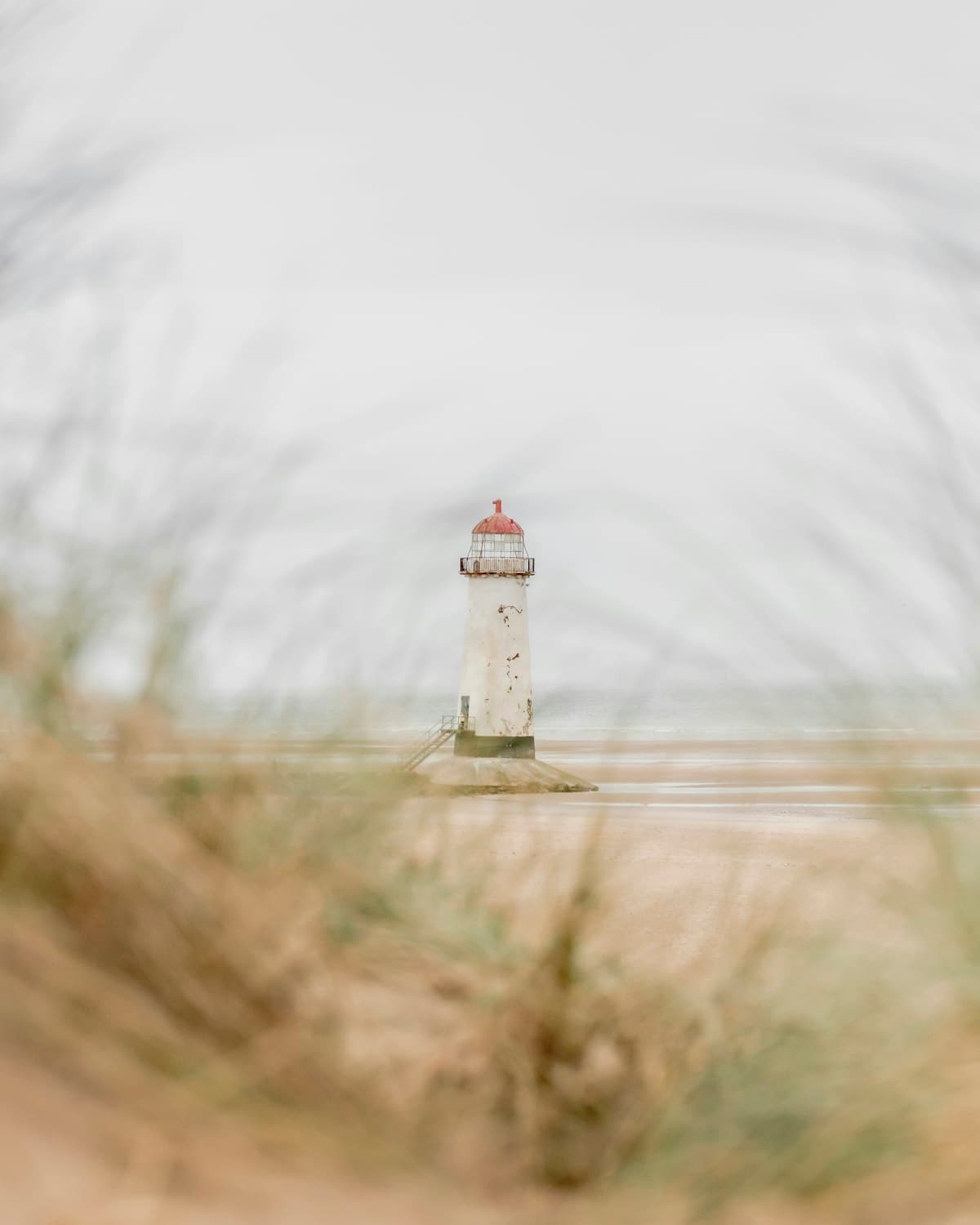
The lighthouse is the star of Talacre Beach, and for good reason. Built in 1776 and decommissioned in 1883, it sits directly on the sand rather than on rocks or a headland, which gives it a slightly surreal quality. At low tide, you can walk right up to its base across the wide, flat beach. At high tide, the sea rises around it, and on stormy days the waves crash against its walls in a way that makes for genuinely striking photos.
You cannot go inside. The structure is fenced off and has been for years, but that does not stop it from being one of the most photographed landmarks on the North Wales coast. Sunrise and sunset are the best times to visit if photography is your thing. The light hits the white tower beautifully at both ends of the day, and if you time it right with a low tide, you get perfect reflections in the wet sand.
What the Beach is Actually Like
Honesty first: Talacre Beach is not a Mediterranean paradise. The sand is golden-brown and firm underfoot, perfect for long walks, but the water of the Irish Sea here runs cold and silty. You are not going to get turquoise waves or crystal-clear swimming conditions. What you do get is space. Serious, wide-open space. At low tide, the beach extends so far out that you can walk for what feels like ages before reaching the waterline.
That openness is what makes talacre beach north wales special. On a breezy day the kite flyers come out. Horse riders use the firmer sand closer to the water's edge. Dog walkers love it because there is room for everyone without feeling crowded. And on a still evening, when the tide is out and the sky goes pink, the whole beach turns into this huge reflective mirror that feels almost otherworldly.
The beach faces north across the Dee Estuary toward the Wirral Peninsula and Liverpool Bay. You can see the wind turbines out at sea and, on a clear day, the outline of Hilbre Island and the Wirral coast. It is an industrial estuary in places, so the views mix natural beauty with working coastline. That is just the honest character of this stretch of shore.
The Sand Dunes and Wildlife
Behind talacre beach sits a proper dune system that is worth exploring on its own. The Gronant and Talacre dunes are a Site of Special Scientific Interest, home to one of the few remaining colonies of natterjack toads in Wales. In spring, you can hear them calling from the dune slacks on warm evenings, a surprisingly loud rasping sound for such a small creature.
The dunes are also good for birdwatching. Little terns nest here in summer, and the estuary beyond draws wading birds through the year. Bring binoculars if you have them. The footpaths through the dune grass are well-trodden but not paved, so sturdy shoes help, especially after rain when things get muddy.
Walking through the dunes gives you a different perspective on the coast. You lose sight of the beach for a while, surrounded by marram grass and wildflowers, and then you crest a ridge and the whole panorama opens up again. It is a nice contrast to the flat expanse of the beach itself.
Getting to Talacre Beach
One of the best things about this beach is how easy it is to reach from the big cities in the northwest. Chester is the closest, just 30 minutes by car along the A548 coast road. Liverpool takes around 50 minutes through the Mersey Tunnel and along the A550. Manchester is further out at roughly 90 minutes, but the route is straightforward via the M56 and A55.
The car park at the end of Station Road in Talacre village is pay-and-display. It is not huge, and it fills up on sunny summer weekends and school holidays. Getting there before 10am on a peak day saves you the frustration of circling. There is no train station in Talacre itself, but Prestatyn station is about three miles away, and you could walk or grab a taxi from there.
Presthaven Holiday Park and Local Amenities
Presthaven Holiday Park sits right beside the beach and is the main accommodation option in the immediate area. It is a Haven park with the usual setup: caravans, entertainment complex, swimming pool, restaurants. If you are staying there, beach access is a short walk through the dunes. For day visitors, the park's facilities are sometimes available, but check ahead as policies change seasonally.
The beach itself has limited facilities. There is a small cafe near the car park that serves hot drinks, bacon rolls, and ice cream. Public toilets are available in the car park area. Beyond that, you are on your own, so bring water and snacks if you are planning a longer walk.
For more options, the town of Prestatyn is a short drive east. It has supermarkets, fish and chip shops, pubs, and sits at the northern end of the Offa's Dyke Path, a 177-mile national trail running the length of the Wales-England border. Rhyl is a bit further along and has a bigger range of seaside amusements and restaurants if that is more your speed. If you are exploring the best beaches in the UK, Talacre deserves a spot on the list for its lighthouse alone.
Practical Tips for Visiting
Tides make a big difference at Talacre Beach. At high tide, the beach shrinks dramatically and the lighthouse stands in the water. At low tide, you get an enormous expanse of sand that is perfect for walking. Check the tide times before you go, especially if you want to walk out to the lighthouse or if you are visiting with young children who want to paddle.
Wind is almost always a factor. The beach is completely exposed, and northerly or westerly winds can make it feel significantly colder than the temperature suggests. Bring layers even in summer. A windbreak is worth packing if you plan to sit for any length of time.
The firmest sand is closer to the waterline, which makes walking and cycling easier down there. Higher up the beach, the sand is softer and looser. Pushchairs and wheelchairs will manage the path from the car park to the beach edge, but getting across the soft sand beyond that is harder.
Talacre Beach is not trying to be a resort beach, and that is exactly its appeal. It is raw, open, and genuinely beautiful in its own understated way. The lighthouse gives it a focal point that most UK beaches lack, the dunes add texture and wildlife, and the sheer scale of the place at low tide makes you feel small in the best possible sense. It is worth the drive.