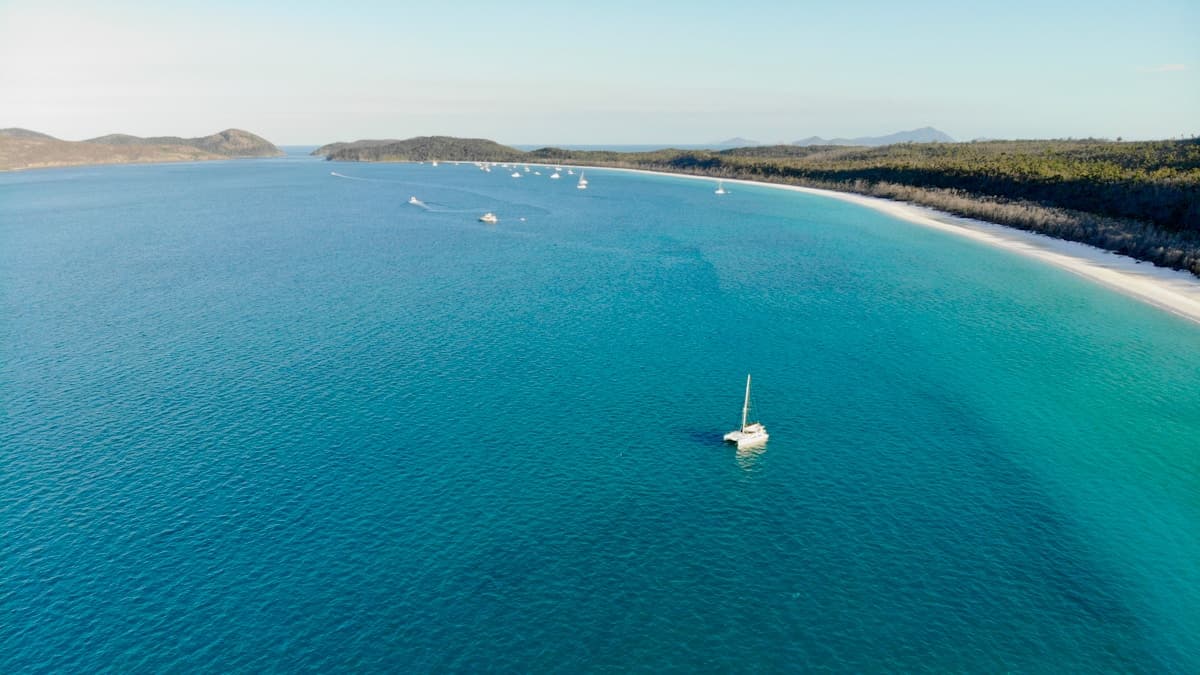

There is a moment on the boat ride out to Whitehaven Beach when the water changes color so suddenly it looks fake. One minute you are crossing the deep blue of the Coral Sea, and then the seafloor rises and everything turns pale green, almost glowing. The first glimpse of sand through that water is so white it barely registers as a beach. It looks like snow dropped into the tropics.
What Makes Whitehaven Beach Whitsundays So Remarkable
The sand at Whitehaven is 98% pure silica. That might sound like a dry geological fact, but it changes everything about the experience. Silica sand does not retain heat the way regular beach sand does. You can walk barefoot across it at midday in the Australian summer without burning your feet. It squeaks slightly underfoot, feels almost powdery between your toes, and stays brilliantly white no matter how strong the sun gets. Seven kilometers of it stretches along the eastern side of Whitsunday Island, backed by dense tropical bushland that runs right down to the shoreline.
The beach sits within the Great Barrier Reef Marine Park, surrounded by some of the most protected waters in Australia. The combination of that impossibly white sand with the shifting turquoise and emerald shallows is why whitehaven beach whitsundays consistently ranks among the best beaches on the planet. Photos do not exaggerate this place. If anything, they undersell it.
Hill Inlet and the Famous Swirling Sands
At the northern end of Whitehaven, a short bushwalk leads up to the Hill Inlet lookout. This is the shot you have seen on every Australian tourism poster. From the elevated platform, you look down on a tidal estuary where sandbars and channels of seawater swirl together in constantly shifting patterns. The colors blend and separate with the tide, creating something that looks more like abstract art than geography.
The walk from the northern beach access point takes about ten to fifteen minutes through shaded forest. It is not difficult, but the trail has some uneven sections and a few sets of stairs. Bring water and wear proper shoes rather than flip-flops. The best time to catch the swirling effect is on a changing tide, roughly two hours either side of high tide, when the water is actively moving through the inlet. Your tour operator will usually time the visit around this.
You can walk down from the lookout to the inlet itself and wade through the shallow channels. The water is warm and barely knee-deep in most places, and the sand beneath shifts and ripples in real time. Standing in the middle of Hill Inlet with the colours moving around you is one of those travel moments that actually lives up to the hype.
Getting There and Tour Options
There is no way to drive to Whitehaven. The beach sits on Whitsunday Island, the largest island in the chain, and reaching it means booking transport from Airlie Beach, the gateway town on the mainland.
Day tours are the most popular option and run daily year-round. A typical half-day trip costs around $150 to $180 AUD (roughly $95 to $115 USD) and includes the boat transfer, a guided walk to Hill Inlet, and a couple of hours on the beach. Full-day tours run $200 to $250 AUD ($130 to $160 USD) and usually add snorkeling stops at fringing reefs nearby. Most operators provide lunch, snorkeling gear, and stinger suits during the relevant season.
For something more immersive, multi-day sailing trips through the Whitsundays are hard to beat. Two or three-night trips on a sailing yacht cost between $500 and $900 AUD ($320 to $580 USD) and typically include Whitehaven along with multiple snorkeling spots and overnight anchorages in sheltered bays. Sleeping on the water under the stars with the Southern Cross overhead is a very different experience from a quick day trip.
Seaplane and helicopter transfers cost more, starting around $300 to $500 AUD ($195 to $320 USD) per person, but the aerial perspective over the reef and islands is stunning and gives you a view of Heart Reef along the way.
When to Visit and the Stinger Season Question
The dry season from June through September delivers the best conditions. Skies tend to be clear, humidity drops, and the water is calm. Winter temperatures in the Whitsundays still sit around 22 to 25 degrees Celsius, which is comfortable for swimming without a wetsuit.
Between October and May, box jellyfish and irukandji are present in the waters. This is stinger season, and it needs to be taken seriously. Tour operators provide lycra stinger suits, and you should absolutely wear one. The stings can range from painful to genuinely dangerous. This does not mean you cannot visit during these months. Thousands of people swim at Whitehaven through summer with stinger suits on. But it is something to be aware of, and skipping the suit because it feels cumbersome is not worth the risk.
The wet season from January through March also brings the possibility of cyclones, which can cancel tours for days at a time. If you are planning a trip during this window, build some flexibility into your schedule.
What to Expect on the Beach
Whitehaven is a national park beach. There are no resorts, no beach bars, no sunbed rentals, and no permanent toilets. There are basic composting toilets at the main access points and that is about it. Everything you bring in, you carry out. Tour operators supply lunch and drinks, but if you arrive independently by private boat, you need to be fully self-sufficient.
The beach gets busiest between about 11am and 2pm when the tour boats from Airlie Beach overlap. The main landing points see clusters of visitors during these windows. But the beach is seven kilometers long. Walk fifteen minutes south from the main drop-off and you will likely have a stretch of sand entirely to yourself. The far southern sections see very few visitors on any given day.
Swimming is excellent along most of the beach. The water is clear, shallow near shore, and generally calm on the protected eastern side of the island. Snorkeling is better at the rocky points at either end of the beach where coral and marine life cluster. If your tour includes a dedicated snorkeling stop at a reef nearby, that will be more rewarding than snorkeling directly off the main sandy stretch.
Practical Tips Worth Knowing
Sun protection is essential. The sand reflects UV light aggressively, and the Queensland sun at this latitude burns fast. Reef-safe sunscreen, a hat, and a rash vest will save you from a painful evening. Bring more water than you think you need, especially if you plan to do the Hill Inlet walk and then spend time on the beach.
There is no mobile phone reception on the island with most carriers, so download any maps or information before you leave Airlie Beach. If you are prone to seasickness, take medication before the boat ride. The crossing can be choppy, particularly on afternoon returns when the wind picks up.
The sand at Whitehaven is so fine that it can damage electronics. Keep cameras and phones in sealed bags when you are not actively using them, and be careful with watch clasps and zippers. The silica particles work their way into everything.
Is Whitehaven Beach Worth the Effort?
Getting to Whitehaven takes planning and money. It is not a beach you stumble upon during a coastal drive. But that inaccessibility is part of what protects it. Without roads or development, the beach stays wild in a way that almost no famous beach on earth manages anymore. The sand really is that white. The water really is that clear. And standing on a seven-kilometer stretch of coastline with no buildings in sight, just forest and sea and that extraordinary colour, it delivers something that is becoming genuinely rare.