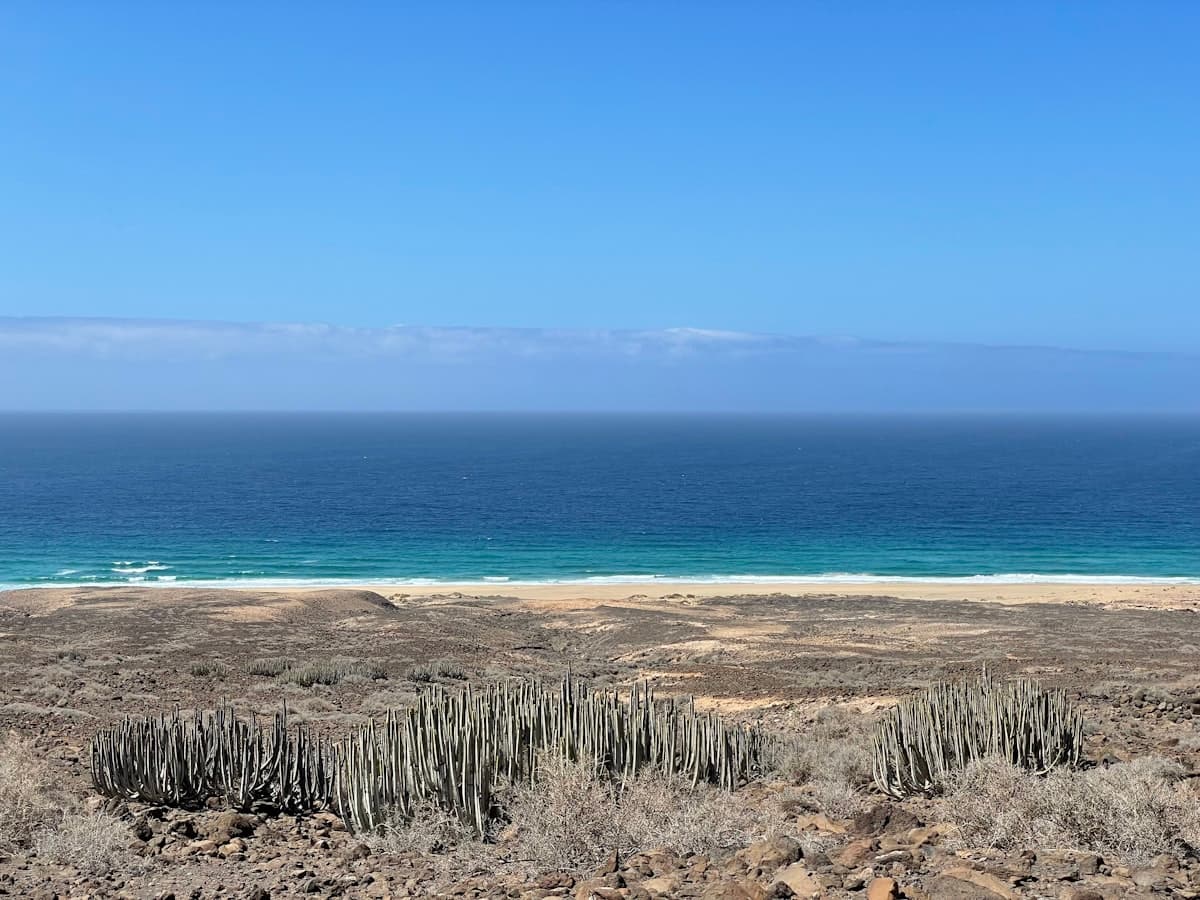
You spend 40 minutes rattling along a dirt road carved into the side of a mountain, dodging potholes and gripping the steering wheel, wondering if your rental car insurance actually covers this sort of thing. Then you reach the viewpoint at the top, look down, and forget about all of it. Playa de Cofete stretches out below you like a coastline from another planet. Twelve kilometers of pale sand, not a single building on it, backed by the dark jagged ridgeline of the Jandia mountains. It is one of the most dramatic beach views in all of Europe, and you earned it. If you are exploring the island, Playa de Sotavento on the opposite coast is the perfect contrast with its turquoise lagoon and kitesurfing scene.
Getting There from Morro Jable
Let's talk about that road, because it is the main reason Playa de Cofete stays so empty. From the resort town of Morro Jable on Fuerteventura's southern tip, you drive west along the coast, past the lighthouse at Punta de Jandia, and then turn onto a rough unpaved track that climbs up and over the spine of the Jandia peninsula. The distance is only about 20 kilometers, but it will take you 40 to 50 minutes because the road is full of loose gravel, sharp bends, and sections where you genuinely wonder if you have made a wrong turn.
A high-clearance vehicle makes the drive more comfortable, but plenty of people do it in standard rental cars every day. Go slow, stay in second gear on the steep bits, and resist the temptation to swerve around potholes at speed. If you would rather not drive, bus line 111 runs from Morro Jable to Cofete a few times daily, which saves your nerves and your car's suspension.
The road alone filters out most of the tourists staying in the resorts on the other side of the peninsula. That is exactly why Cofete feels the way it does.
The Beach Itself
Playa de Cofete runs for roughly 12 kilometers along Fuerteventura's exposed western coast, facing straight out into the open Atlantic. The sand is golden and fine, the kind that squeaks under your feet, and on a typical day you can walk for half an hour in either direction without passing another person. The scale of this place is hard to capture in photographs. You feel small here, and that is the whole point.
Behind the beach, the Jandia mountains rise steeply, their slopes barren and volcanic, streaked with shadows that shift as the clouds roll over. The contrast between the pale sand, the dark mountains, and the white surf crashing in from the Atlantic is stunning. Photographers love this spot for good reason, and the light in the late afternoon turns everything golden.
The wind is a constant companion at Cofete. This is the exposed Atlantic side of the island, and the breeze rarely drops below a steady blow. Some days it is gentle enough to enjoy. Other days it will sandblast your legs and make setting up a towel an exercise in frustration. Check the forecast before you go, and bring something to anchor your belongings.
Swimming: Look, Don't Touch
Here is the part where you need to pay attention. The water at Playa de Cofete looks inviting, but it is genuinely dangerous. Strong Atlantic currents run along the shore, and the undertow can pull even strong swimmers out before they realize what is happening. There are no lifeguards, no safety flags, and no one coming to help if things go wrong. People have drowned here.
Wading up to your ankles is usually fine. Going deeper than your knees is a gamble, and going for a full swim is something most experienced locals would advise against. This is a beach for walking, sitting, watching the waves, and letting the scale of the landscape do its work on you. It is not a beach for swimming.
Villa Winter and Its Mysteries
About a kilometer inland from the beach sits Villa Winter, an odd and slightly eerie abandoned mansion that adds a layer of intrigue to an already atmospheric place. Built in the 1940s by a German engineer named Gustav Winter, the house has generated decades of speculation about its true purpose. Some say it was a secret communications base during World War Two. Others claim it served as a supply point for German submarines operating in the Atlantic. The most outlandish theories involve hidden tunnels and escaped officials.
None of these stories have been definitively proven, and the truth is probably more mundane. But standing in front of this crumbling villa with the wind howling off the mountains and not another soul in sight, the conspiracy theories feel oddly plausible. You can view the building from the outside, and sometimes a caretaker will let you look inside for a small donation. It is worth the short detour.
No Facilities, No Problem
Cofete is not set up for comfort. On the beach itself there is nothing. No toilets, no showers, no shade structures, no sunbed rentals. The only food option is Restaurante Cofete, a small place in the village at the top of the hill before the road descends to the shoreline. The food is simple, portions are generous, and after the drive in, a cold drink on their terrace feels like a reward.
Bring at least two liters of water per person, sunscreen, a hat, and a windbreaker. If you are planning to spend several hours on the beach, pack lunch. There is nowhere to buy anything once you are down on the sand.
Why Bother with All of This
You might be reading this and thinking it sounds like a lot of effort for a beach where you cannot even swim. And honestly, if your ideal beach day involves a lounger, a cocktail, and calm water, Cofete is not for you. There are dozens of beaches on Fuerteventura that deliver exactly that experience, and they are excellent.
But Cofete offers something different. It is one of the last truly wild beaches in the Canary Islands, a place where the landscape has not been tamed or packaged for tourists. The drive in is part of the experience. The emptiness is the experience. You stand on 12 kilometers of sand with mountains at your back and the Atlantic throwing waves at your feet, and for a while, the rest of the world stops mattering.
The best approach is to arrive mid-morning, walk the beach for an hour or two, visit Villa Winter, eat at the restaurant, and drive back before the afternoon wind picks up. Give yourself a full half-day for the trip. You will be tired and slightly windblown by the end of it, but you will have seen something that most visitors to Fuerteventura never bother to find.
The Honest Take
Playa de Cofete is not a beach for everyone. The access is rough, the swimming is off-limits, the wind can be relentless, and there is almost nothing in the way of creature comforts. It scores low on convenience and high on everything else.
If you want raw, unspoiled coastline that makes you feel like an explorer rather than a tourist, Cofete delivers that better than almost anywhere else in Europe. For more off-the-beaten-track recommendations, check out our best beach holidays in Europe guide. The dirt road is the price of admission. Pay it.