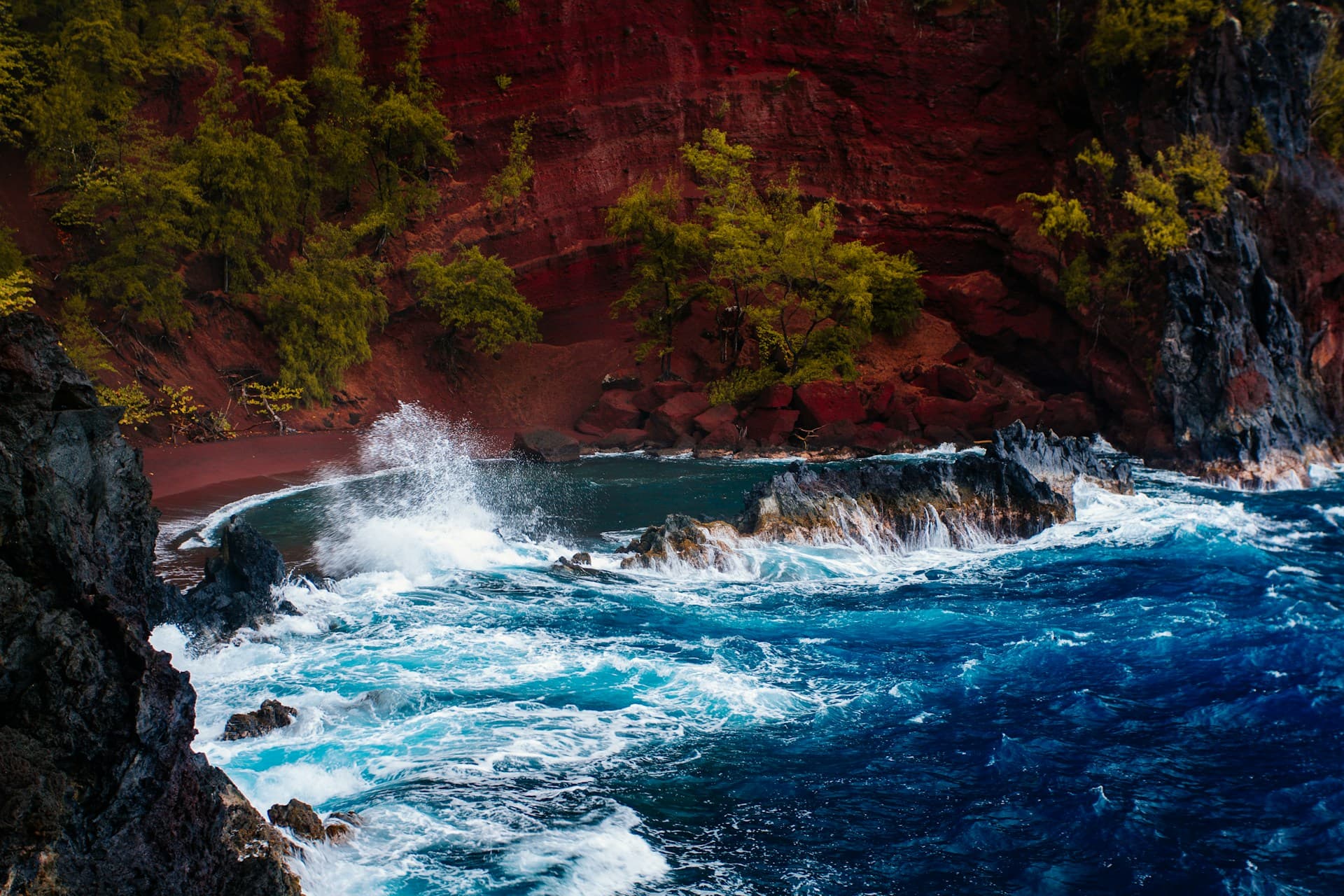
Kaihalulu Beach sits on Maui's far eastern tip, just south of Hana Bay, hidden behind a crumbling volcanic hill that most people drive right past without knowing the beach exists. The name means "roaring sea" in Hawaiian, but the beach itself is better known for its colour. The sand here is a deep, rust-toned red, formed from the slow erosion of Ka'uiki Head, the iron-rich cinder cone that towers above the cove. It is one of the most visually unusual beaches in Hawaii, and easily one of the hardest to reach on Maui. If dramatic cliff-framed beaches appeal to you, Kelingking Beach in Bali has a similarly challenging trail with equally stunning payoffs.
Getting here is the real story, though. The trail that leads to the beach is not a maintained path. It is a narrow, eroding scramble across the face of Ka'uiki Head that has been partially closed, reopened, closed again, and remains in a state of "use at your own risk" depending on who you ask. People do get hurt here. That fact deserves to be front and centre before anything else.
Finding the Trailhead
You will not find signs pointing you to Kaihalulu. From Hana town, head to the area around Hana Bay. Most people park near the Hana Community Center or along the road by the baseball field. From there, walk south along the grassy area until you spot the Japanese cemetery on the hillside to your left. The cemetery, with its weathered stone markers and small carved monuments, is your landmark. The trail to the beach starts just past it, heading around the seaward side of Ka'uiki Head.
There is no formal trailhead, no ticket booth, no information board. You are walking onto land that local residents consider culturally significant, and showing respect for that is not optional.
The Trail (Be Honest With Yourself)
The path from the cemetery to the beach is roughly 10 to 15 minutes of walking when conditions are dry. That does not sound like much, but the trail is genuinely precarious in places. It cuts across a steep hillside of loose red cinder with a drop-off to jagged rocks and ocean below. The ground crumbles underfoot. In some sections the path narrows to barely a foot wide, and you are grabbing onto whatever vegetation or rocks you can find for balance.
After rain, this trail becomes significantly more dangerous. Wet cinder is slippery in a way that is hard to overstate. Flip-flops and sandals are a terrible idea here. Wear shoes with real grip. If you look at the trail and feel uncomfortable, turn around. There is no lifeguard station, no railing, no rescue service waiting at the bottom. A fall on the exposed sections would mean landing on volcanic rock or in rough water.
The trail has deteriorated over the years. Sections that older travel guides describe as "a bit tricky" have eroded further, and what was once a sketchy-but-passable route is now genuinely risky in spots. Be realistic about your ability and comfort level.
The Beach and the Cove
Once you make it around the headland, the red sand beach opens up below you in a sheltered crescent-shaped cove. The colour really is remarkable. Deep red, almost burnt sienna, with veins of black mixed through where different volcanic material has washed in. It looks nothing like any other beach you have visited in Hawaii.
The cove is partially protected by a natural wall of dark lava rock that extends out from Ka'uiki Head and creates a barrier against the open ocean. This makes the water inside the cove calmer than you would expect on this stretch of coast. On a still day, the water is clear enough to see the rocky bottom, and snorkelling along the inner edge of the lava wall can be surprisingly good. You will see tropical fish, sea urchins, and the occasional turtle cruising past.
That said, the gap in the rock wall lets current and swell push through, and conditions change quickly. Stay inside the protected area and do not swim out past the rocks. There are no lifeguards, and the nearest help is a slippery 15-minute scramble back up the trail followed by a drive to wherever you can find someone with a phone signal.
What to Bring
There are zero facilities at Kaihalulu Beach. No toilets, no shade structures, no vendors, nothing. Bring water, sunscreen, a towel, and something to carry your trash out in. The beach itself has limited natural shade, mostly from the cliff face in the morning hours. By midday the cove heats up considerably, and the red cinder radiates heat in a way that pale sand does not.
If you plan to snorkel, bring your own gear. There is nowhere to rent equipment in Hana, and the nearest dive shop is hours back along the Road to Hana.
Getting to Hana
The bigger question for most visitors is getting to this part of Maui at all. Hana sits at the end of the famous Road to Hana, a winding 64-mile drive from Kahului that takes roughly three hours each way without stops. Most people turn it into a full-day trip or stay overnight in Hana to avoid the white-knuckle return drive after dark.
If you are staying in Hana, Kaihalulu is a short walk from town and makes for a solid morning excursion. Hit the trail early, before 9 AM, when the cinder is dry and the cove is still shaded by the cliffs. You will likely share it with only a few other people, or nobody at all.
The Clothing-Optional Question
Kaihalulu has long been known as a clothing-optional beach. This is technically against Hawaii state law, but enforcement at a beach this remote and hard to reach is effectively nonexistent. You may encounter nudity, and it should not come as a surprise. If that is not for you, it is worth knowing before you make the trek.
Worth the Risk?
That depends entirely on your comfort with the trail. The beach is genuinely beautiful and unlike anything else on Maui. The red sand against turquoise water, the raw volcanic landscape, the sense of isolation just minutes from a small town. It all works. But the access trail is not a joke, and people have been injured badly enough to require helicopter evacuation from this area. If you are sure-footed, wearing proper shoes, and visiting on a dry day, it is a memorable experience. If the trail makes you nervous at any point, there is no shame in turning back. Hana Bay is a perfectly lovely spot to spend your morning instead. For a much more relaxed Hawaiian beach day, Ewa Beach on Oahu offers calm waters and a local community vibe.