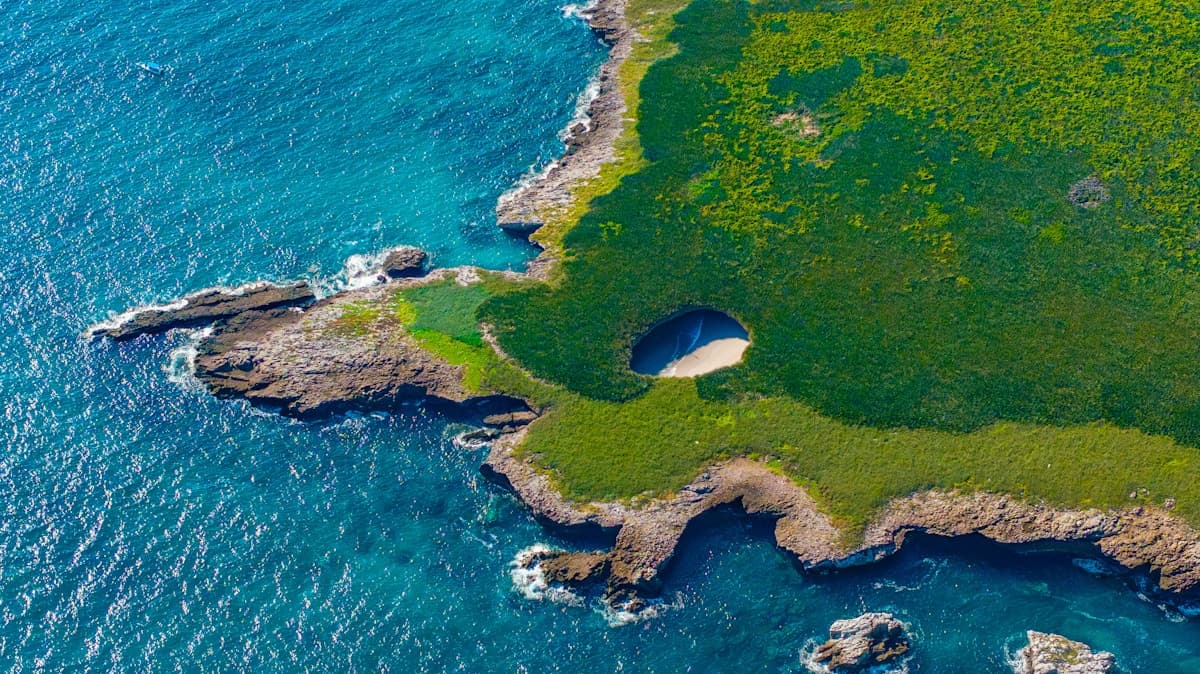
Somewhere off the coast of Puerto Vallarta, about an hour by boat from the dusty beach town of Punta de Mita, there is a beach that should not exist. Playa del Amor sits inside a collapsed volcanic crater on the Marietas Islands, completely hidden from the outside world. The only way in is through a short water tunnel that opens during low tide. You swim through darkness for maybe ten seconds, surface on the other side, and find yourself standing on golden sand inside what feels like a roofless cathedral carved from rock. The Pacific sky hangs directly overhead. Waves lap gently at the shore. The walls of the crater rise around you, draped in green vegetation and pocked with seabird nests. It is one of the strangest and most beautiful places you will ever visit, and getting there takes more planning than most people expect.
What You Are Actually Looking At
The Marietas Islands are a small volcanic archipelago sitting about 35 kilometers off Mexico's Riviera Nayarit coastline. They were formed thousands of years ago by volcanic activity, and the Mexican military used them as a bombing test site in the early 1900s. The prevailing theory is that the crater housing Playa del Amor was created or significantly enlarged by one of those explosions, which blew open the top of a coastal cave system. What remains is an oval-shaped beach roughly 30 meters across, surrounded by rock walls that rise about 25 meters, with a ragged hole in the ceiling that lets in sunlight and rain.
The water inside the crater is shallow, warm, and sheltered from ocean swells. The sand is soft and surprisingly fine for a volcanic beach. Looking up from the sand, you can see frigatebirds circling overhead and blue-footed boobies perched on the crater rim. The whole scene has a quality that photographs struggle to capture. It looks like something a film studio would build and then reject for being too unrealistic.
The Booking Situation Is Non-Negotiable
Here is the single most important thing to know about visiting Playa del Amor: you cannot just show up. The Marietas Islands are a UNESCO Biosphere Reserve and a protected national park. The Mexican environmental agency SEMARNAT limits access to 116 visitors per day, and only licensed tour operators are allowed to bring people to the hidden beach. No private boats. No kayaking over on your own. No exceptions.
This means you need to book a tour in advance, especially during the high season from November through May. During Christmas, New Year, and Semana Santa, spots fill up weeks ahead of time. Tour operators are based in Punta de Mita, Sayulita, and some operate from Puerto Vallarta's marina. Expect to pay between $80 and $120 USD per person for a half-day trip that includes boat transportation, snorkeling equipment, and your entry permit. The permit itself is included in the tour price, and your operator handles the paperwork.
Do not try to book with random guys on the beach offering "island tours" for cheap. Unlicensed operators risk heavy fines, and if they get caught, you get turned away at the island. Stick with established companies that can show you their SEMARNAT authorization. It is worth asking your hotel for recommendations, since locals know which operators are reliable.
Getting Through the Tunnel
The boat ride from Punta de Mita takes about 30 to 45 minutes, depending on sea conditions. Once you reach the Marietas Islands, the boat anchors in a sheltered bay and your guide explains the swim. The tunnel entrance is a gap in the rock face at water level, roughly 2 meters wide and about 6 meters long. You swim through it wearing a life jacket, and your guide goes first.
The swim is short but can feel intense if you are not comfortable in open water. The tunnel is dark, the current can push and pull depending on the tide, and there is a moment when you cannot see either the entrance or the exit. Most people handle it fine. Children under a certain age and non-swimmers are typically not allowed, though policies vary by operator. Ask when you book.
Timing matters enormously here. The tunnel is only passable during low to medium tide. When the tide is high or the seas are rough, access is denied entirely, no matter what you paid. Your tour operator will schedule the trip around the tide chart, but Mother Nature always gets the final say. Cancellations due to conditions happen, and reputable operators will reschedule or refund you.
What to Do Once You Are Inside
Your time on the hidden beach is limited. Most tours give you about 30 to 45 minutes inside the crater, which sounds short but feels surprisingly generous once you are there. The beach is small, and the main activities are simple: swim in the warm, clear water, float on your back staring up at the open sky, and take as many photos as your phone storage allows.
Before or after entering the crater, most tours include snorkeling around the outer edges of the Marietas Islands. The water clarity here is excellent, and the marine life is abundant. Expect to see tropical fish, sea urchins, manta rays, and if you visit between December and March, humpback whales pass through these waters on their annual migration. Whale watching from the tour boat is a genuine highlight that often surprises people who came only for the beach.
The islands are also home to one of Mexico's most important seabird colonies. Blue-footed boobies, which look exactly as ridiculous as their name suggests, nest along the rocky shoreline by the hundreds. Frigatebirds patrol overhead. If you are into wildlife, bring binoculars and keep them in a dry bag for the boat ride.
When to Go and What to Bring
The best window is November through May, when seas are calmest and the weather is dry. June through October brings heavier swells, more rain, and higher chances of your tour getting cancelled. August and September are particularly rough, and some operators shut down entirely.
Water temperatures hover around 24 to 28 degrees Celsius year-round, so a wetsuit is unnecessary for most people. Bring reef-safe sunscreen, water shoes for the rocky approach, and a waterproof bag or case for your phone. Everything you bring needs to survive a short swim through a tunnel, so pack light and pack smart. There are no facilities on the island. No bathrooms, no shops, no freshwater rinse stations. Your boat is your base, and the crew will usually have water and snacks waiting when you get back.
The Honest Take
Playa del Amor deserves its fame. Standing on that sand, looking up through the broken ceiling of a volcanic crater at the blue Pacific sky, is a genuinely singular experience. There is nowhere else on earth quite like it, and the strict visitor limits mean it has not been loved to death the way so many other Instagram-famous beaches have.
But go in with your eyes open. The visit is short, the logistics are involved, and the whole thing depends on tides and weather cooperating. You will spend more time on the boat than on the beach, and there is a real chance conditions could shut you out entirely. If that happens, the snorkeling and whale watching around the islands are still worth the trip, but you might feel the sting of $100 spent without setting foot on the sand.
Book early. Book licensed. Check the tide chart. And if the tunnel is passable and you swim through that dark gap and surface into the sunlight on the other side, you will not soon forget it.